AIO, GEO & Search Engine Optimisation (SEO) Consultant
Hire the Best AIO, GEO & SEO Consultant having 16 Years of Experience
Guide your internal marketing staff with 16 years of hands-on search architecture, eliminate execution drag, and unlock high-intent organic market share without the overhead of costly managerial hires.
Sustaining organic visibility in competitive sectors requires steady technical governance rather than repetitive trial and error. Growing establishments, specialized clinics, and regional institutions frequently face a common bottleneck: they either hire detached marketing agencies that charge heavy retainers for automated reports, or they rely on junior executives who lack the architectural depth needed to steer through major algorithm shifts.
Engaging a dedicated AIO and search engine optimisation consultant resolves this operational friction. Rather than absorbing executive salaries or letting junior teams guess their way through crawl errors, your organization secures experienced search leadership. The frameworks, technical blueprints, schema structures, and editorial models are set by an AIO, GEO & SEO Expert, while manual CMS tasks and routine uploads are handled efficiently by your affordable in-house team.
Fractional Search Leadership & Operational Economics
How the strategic advisory model separates high-level search architecture from daily manual execution, delivering senior oversight at a fraction of enterprise payroll.
Annual Overhead Comparison (Capital Outlay)
Sharad Rohatgi (Consultant)
- ✓ AIO & GEO Architecture: Vector extraction formatting, direct answer triggers, and LLM citation optimization.
- ✓ Advanced Technical Schemas: Authoring nested JSON-LD graphs (MedicalWebPage, Physician, Organization).
- ✓ Crawl & Index Governance: Diagnosing Search Console anomalies, crawl budgets, and canonical structures.
- ✓ Conversion UX Blueprints: Designing page hierarchies, data matrices, and intent-focused layout modules.
- ✓ Weekly Sprint Management: Formulating step-by-step SOPs, assigning tickets, and auditing staged pages.
In-House Marketing Executive
- ✦ CMS Page Assembly: Staging content in WordPress, formatting headings, and uploading approved media.
- ✦ Drafting from Outlines: Producing baseline copy according to provided E-E-A-T clinical briefs.
- ✦ Routine Profile Maintenance: Scheduling weekly Google Business Profile posts, photos, and basic updates.
- ✦ Ticket Execution: Implementing weekly sprint tasks without strategic ambiguity or guesswork.
- ✦ Internal Link Staging: Weaving approved contextual anchors into live CMS posts as instructed.
The Financial Audit: Operational Models Compared
Clinic promoters and enterprise directors must continually balance capital efficiency against strategic control. When scaling organic traffic, organizations typically evaluate four paths:
| Operating Vector | Option 1: Traditional Agency | Option 2: Full-Time Director | Option 3: Promoter-Led | Option 4: Sharad Rohatgi (Consultant) |
|---|---|---|---|---|
| Cost Structure | ₹30,000 – ₹80,000 / month retainer with rigid scope limits. | ₹12,00,000 – ₹18,00,000 annual CTC plus benefits and bonuses. | Junior salary plus significant lost executive leadership hours. | Lean advisory retainer plus affordable junior in-house payroll. |
| Keyword Scope | Strict contractual limits (e.g., capped at 20 to 30 keywords). | Uncapped, but limited to personal execution time. | Unfocused keyword chasing driven by ad-hoc queries. | Zero keyword brackets. Full topical authority across your vertical. |
| Strategic Depth | Rotating account managers; standardized boilerplate deliverables. | High depth, but builds an expensive single-point dependency. | Fragmented; promoter studies algorithm updates while managing the business. | Direct access to 16 years of clinical, enterprise, and search experience. |
| Management Burden | Chasing agency representatives for deliverables and answers. | HR performance evaluations, retention risk, and payroll friction. | Promoter spends 10–15 hours weekly micro-managing daily steps. | Structured weekly governance sprints with zero micro-management. |
| Data & IP Ownership | Opaque workflows; custom setups often tied to agency tools. | Internalized, but vulnerable to turnover if leadership resigns. | Unstructured processes without formal operational documentation. | 100% in-house IP. Clean SOPs built straight into your company systems. |
The Leadership Dilemma
When a founder or clinical director attempts to lead search engine optimization personally, an operational imbalance occurs. Guiding junior executives without senior technical backing forces the business owner to examine indexing reports, review tag structures, and troubleshoot crawl errors.
Spending several hours each week on digital execution pulls attention away from primary clinical consultations, facility management, and institutional partnerships. Because ranking algorithms evolve continually, the promoter is forced into the role of a part-time marketer. The enterprise incurs two expenses: junior payroll and the high opportunity cost of diverted executive focus.
Uncapped Keyword Scope
Many marketing retainers restrict clients with arbitrary caps, charging extra fees once a project exceeds 20 or 30 keywords. This artificial limit runs counter to how modern search systems function.
Search engines evaluate contextual depth across an entire subject area rather than isolated phrases. Under this advisory model, there are no keyword brackets. Operating as your strategic brain, the objective is comprehensive topical coverage. Every procedure nuance, patient inquiry, and related secondary topic is mapped out so your internal team can systematically build lasting authority.
Holistic Performance Governance: SEO, AIO, & Conversion UI
Organic visibility cannot develop in isolation. Modern discovery algorithms analyze how well technical page architecture, search intent, brand entities, and user conversion flows work together.
Search Engine Optimisation
Structuring crawl efficiency, logical URL paths, nested JSON-LD schema graphs (Physician, Organization, MedicalWebPage), on-page semantic siloing, and precise internal link networks so crawlers index every page accurately.
AI Engine Optimization (AIO)
Formatting digital assets to gain citations inside AI Overviews and conversational answer engines (like ChatGPT and Perplexity). We turn static web pages into direct, factual answer sources that LLMs easily parse.
Social Entity Alignment
Connecting external professional profiles, clinic channels, and digital mentions to reinforce your primary entity in search knowledge graphs, ensuring brand validation across multiple platforms.
Conversion UI Guidance
High search impressions deliver little value if visitors bounce. Drawing from 16 years of WordPress, CRM workflows, and landing page engineering, we design clean layouts that smoothly guide visitors toward consultation inquiries.
Performance Responsibility: As your consulting partner, I take direct ownership of establishing technical benchmarks for your website, search visibility, and AI engine presence. We define weekly sprint targets, audit staged pages, and ensure junior staff execute work to exact standards.
Technical Schema & Knowledge Graph Blueprint
Bridging on-page clinical content with Google's entity graph, Google Business Profiles, and external trust registries through multi-nested JSON-LD protocols.
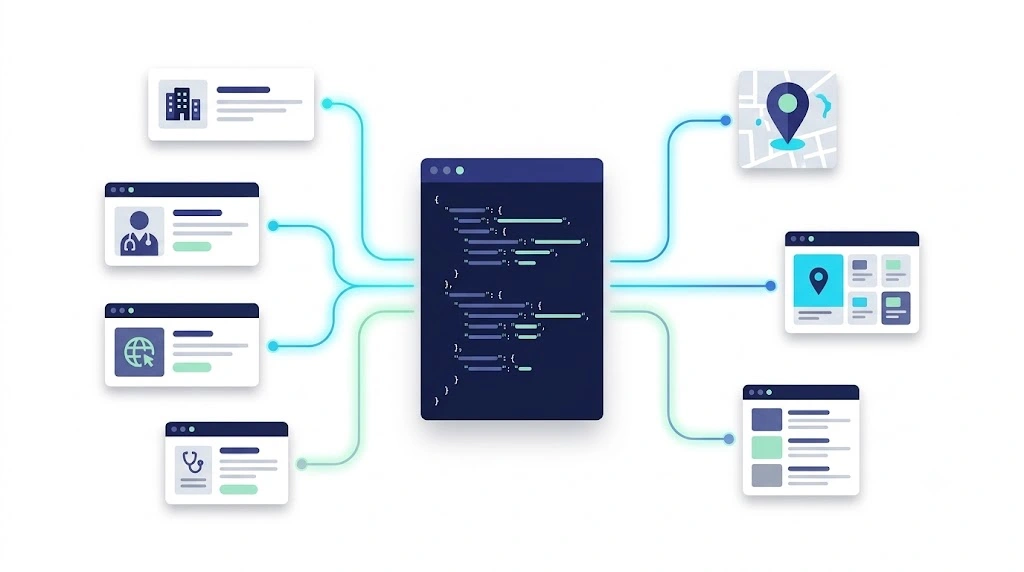
The Core JSON-LD Syntactic Hub
Search crawlers no longer rely on unverified HTML body text to evaluate medical credentials. The central code repository nests MedicalWebPage, Physician, and Organization schemas into an interconnected @graph array, defining primary specialties, procedural catalogs, and editorial oversight in clean syntax that algorithms parse with zero ambiguity.
Knowledge Graph Triangulation
These structured nodes extend outwards to establish continuous verification across Google's Knowledge Graph, verified local map registries (Google Business Profile), official board certifications, and regional directories. By explicitly matching geographic coordinates and verified identifiers, the website transforms from an isolated URL into a recognized digital authority.
Navigating the AI Era: E-E-A-T & Algorithm Defense
The widespread availability of automated text generation has changed search engine evaluations. Inexperienced operators frequently make the mistake of publishing generic AI drafts in bulk, hoping volume alone will improve rankings.
Algorithm Quality Safeguards
Search engines use refined quality filters to isolate and downgrade repetitive, low-substance content. In regulated verticals—especially healthcare, legal, and precision engineering sectors governed by strict YMYL (Your Money or Your Life) standards—publishing generic summaries carries substantial risk. When search algorithms detect content that lacks genuine expertise, visibility often drops sitewide across key service pages.
The Information Gain Advantage
Maintaining visibility requires prioritizing Information Gain. Search systems reward pages that offer clear clinical insights, verified practitioner credentials, structured data tables, and practical perspectives that automated models cannot reproduce:
- Verified E-E-A-T Standards: Demonstrating Experience, Expertise, Authoritativeness, and Trustworthiness through accurate procedural descriptions, clinical reviews, and structured author attribution.
- Topical Entity Networks: Building connected page groups that address core themes thoroughly rather than chasing disconnected search phrases.
- Direct Answer Formats: Structuring concise explanation blocks so search crawlers and generative summaries can cite your business as a primary source.
Local Dominance: Unlocking the Missing 80% in Google Business Profiles
For clinical practices, hospitals, and regional service hubs, patient bookings depend heavily on Google Business Profile (GBP) and Maps prominence. Beginners often assume local optimization is limited to basic tasks: publishing weekly banners, updating hours, and collecting reviews.
The Visible 20% (Beginner Tasks)
- Uploading basic facility photos and promotional banners.
- Replying to patient reviews with standard generic templates.
- Updating holiday operating hours and phone contact details.
- Gathering general reviews without procedural keyword references.
The Hidden 80% (Algorithm Drivers)
- Structuring primary and secondary categories to match website silos.
- Natural review integration referencing specific procedures and technologies.
- Validating business entities across authoritative regional directories.
- Connecting website landing page relevance directly to your Maps pin.
My advisory methodology preserves strong visibility for healthcare institutions and regional centers. We address the underlying 80%: linking site landing pages to verified registries, integrating geographic coordinates into schema code, and structuring local profiles to capture high-intent procedural inquiries across target areas.
Editorial Engineering: High-Yield Headlines vs. Weak Blog Titles
The titles assigned to supporting content determine whether topical authority flows into your core commercial services or remains isolated in low-intent articles. Junior teams often write generic informational posts that attract casual visitors who leave quickly.
| Weak / Generic Blog Titles | Strategic / Consultant-Led Architecture |
|---|---|
|
"Tips for Healthy Skin in Summer" ❌ Lacks commercial intent; draws casual readers who bounce. |
"Managing Heat-Induced Rosacea: Barrier Repair Protocols for Fitzpatrick IV–VI" ✔ Connects clinical symptoms directly to dermatology consultation pages. |
|
"Why Do My Teeth Hurt?" ❌ Overly broad; fails to highlight specialized surgical care. |
"Persistent Pain After a Root Canal: Identifying Missed MB2 Canal Anatomy via 3D CBCT" ✔ Targets high-value patient cases; bridges naturally to endodontic retreatment. |
|
"What is Air Pollution?" ❌ Informational definition; zero commercial or institutional value. |
"Mitigating Industrial PM2.5 Infiltration: High-Volume HEPA & Carbon Air Purification Engineering" ✔ Reaches facility managers, architects, and enterprise procurement heads. |
The Pioneer's Dilemma: Category Creation vs. Channel Alignment
A common misconception among business leaders is that traffic acquisition alone guarantees commercial growth. When search campaigns fail to translate into signed contracts, companies often blame keyword bids or algorithm updates. In practice, the breakdown typically stems from an architectural mismatch between user search intent, landing page UX, and channel distribution across the broader digital marketing landscape.
This diagnostic case study highlights the strategic turnaround of a clean-air technology pioneer operating in the residential and commercial air purification space since 2009—long before the category gained mainstream consumer recognition in India.
The Conversion Bottleneck
During the early phase (2009–2010), awareness around air purification was minimal. Search volumes were low, and traditional directories like Justdial lacked structured categories for environmental health tech. This made paid search via Google Ads the only viable real-time intent vehicle. Despite deploying a monthly search budget of ₹90,000, the company experienced minimal inbound inquiries and an alarming 82% bounce rate.
A diagnostic audit revealed that the website was structured as a flat, unsegmented catalog that failed to capture visitor intent. By restructuring the information architecture, engineering specialized landing pages for separate commercial and residential needs, and aligning on-page content with structured SEO frameworks, the bounce rate dropped from 82% to 12%, turning paid traffic into qualified sales inquiries.
Category Disruption Dynamics
By 2016, market dynamics shifted. While the company initially captured sales on e-commerce platforms like Amazon, the entrance of multinational consumer brands transformed the retail space. Major conglomerates entered with vast capital reserves, brand equity, and established dealer networks, quickly dominating retail marketplace share.
Recognizing that competing on thin retail hardware margins was unsustainable, the business made a strategic pivot: step away from saturated retail units and focus on high-ticket commercial air purification (hotels, healthcare facilities, restaurants, and food processing plants).
The Search Mismatch
The pivot encountered an immediate obstacle on Google Search. Cost-Per-Click (CPC) rates had risen from ₹30 to over ₹90. More critically, search engines operate on demand capture—relying on active, conscious queries.
Commercial decision-makers were not actively searching for "commercial air purifiers" because the sector was still emerging. When the company bid on broader category terms, 98% of searchers were residential consumers seeking home units. Applying negative keywords eliminated consumer clicks but collapsed commercial search volume to near zero. The company was paying ₹90 per click for residential searchers who had zero intent to commission industrial HVAC-grade installations.

Creative Intent Engineering for B2B Discovery
To solve this targeting impasse, we redirected the budget from intent-capture search bars to Meta’s discovery environment (Meta Ads). The objective shifted from waiting for search demand to proactively generating it in front of verified stakeholders.
Instead of promoting engineering metrics like CADR ratings or CFM airflow—which mean little to an executive—the ad creative connected directly to business revenue. For restaurateurs and hoteliers, as highlighted in the visual, the message centered on customer behavior: "If they don't LEAN BACK, they won't STAY LONG. Same guest. Different billing."
Indoor air quality was repositioned from an invisible utility cost into a measurable operational asset that extends table dwell times and increases revenue per cover.
Algorithmic Discovery Shift
By deploying vertical-specific campaigns tailored for corporate CEOs, hotel directors, restaurant owners, hospital administrators, and industrial procurement heads, we bypassed the limitations of search volume.
Meta’s machine-learning algorithms optimized delivery around profiles that engaged with the B2B messaging. Through behavioral signals and lookalike audience modeling, the platform routed impressions directly to verified facility stakeholders across regional commercial hubs, lowering customer acquisition costs and driving qualified B2B contract pipelines.
| Strategic Metric | Google Search Ads (Intent Capture) | Meta Discovery Ads (Intent Generation) |
|---|---|---|
| Channel Mechanism | Pull: Waits for users to enter explicit search queries. | Push: Delivers business insights directly into executive feeds. |
| Search Intent Reality | 98% residential consumers seeking bedroom units. | Precision targeting of verified CEOs, Hoteliers, and F&B Directors. |
| Economic Efficiency | ₹90/click spent on unqualified retail clicks; negative ROI. | Controlled cost-per-lead; highly qualified institutional pipeline. |
| Messaging Angle | Generic technical specifications (CADR, CFM, HEPA). | Direct commercial impact: guest retention, employee productivity, FSSAI compliance. |
The Strategic Takeaway
Search engine optimization and digital marketing are not isolated exercises in keyword rankings. True strategic consulting lies in diagnosing the broader commercial landscape: identifying when to capture search intent, when to structure pages for AIO and GEO discovery, and when to redirect marketing capital to discovery channels where high-value commercial audiences actually engage.
Engaging an experienced AIO, GEO & SEO consultant ensures your organization builds a cohesive, performance-driven growth engine rather than burning marketing spend on disconnected tactics.

Sharad Rohatgi
Fractional Head of SEO • Search Systems StrategistWith 16 years of hands-on optimization across highly competitive, regulated verticals—including specialized medical institutions, surgical practices, and enterprise technologies—Sharad bridges high-level search architecture with disciplined business realities. Rather than executing manual repetitive tasks, he provides in-house marketing divisions with the strategic governance, AI vector discovery frameworks, and technical schematics needed to establish lasting search authority.
16-Year Search Moat
Direct experience leading information architecture through every major Google shift, from PageRank algorithms to generative neural synthesis.
25-Year Yogic Precision
Disciplined bio-mechanical understanding and observational focus, delivering empathetic, anatomically coherent guidance for healthcare brands.
Macro-Demographics
Aligning content taxonomies with regional purchasing power, shifting consumer demographics, and private healthcare demand curves.
The Strategist's Profile: Discipline, Biology, & Macro-Economics
An experienced SEO Specialist provides far more than familiarity with software tools. Thorough search strategy requires consistent pattern recognition, steady analysis during algorithm changes, and an understanding of how buyers evaluate options.
Sixteen Years of Mastery
My advisory background spans 16 years of direct optimization within high-value, regulated verticals. I have developed search architectures for medical fields—such as Dermatology, Hair Restoration, Cosmetic Surgery, Urology, Dentistry, and Ophthalmology—alongside competitive B2B sectors like Corporate Legal Services, Consumer Durables, and Industrial Air Purification.
Having witnessed search evolve from simple keyword matching to neural semantic understanding, I provide internal teams with tested, stable execution paths rather than temporary workarounds.
Discipline and Biological Focus
Rather than reacting hastily to industry rumors, my consulting perspective is supported by 25 years of daily yoga practice, active physical conditioning, and structured nutritional habits. This daily routine directly enhances my strategic work:
- Observational Stamina: Managing long-term search roadmaps calls for careful data examination, helping me detect indexing changes that automated dashboards miss.
- Realistic Healthcare Framing: An ongoing personal understanding of bodily mechanics and physiology helps me review medical content for natural clarity and empathetic tone, ensuring it reads like authentic clinical guidance rather than generic marketing text.
Macro-Demographics and Demand
Search trends reflect broader economic realities. My strategy work incorporates ongoing analysis of regional demographics, rising household incomes, and private healthcare spending patterns.
By tracking these economic demand shifts, we help your internal staff focus content production on high-value procedural services (such as full-arch dental implants or advanced dermatological therapies) where patient purchasing readiness and search interest meet.
Frequently Addressed Strategic Inquiries
How does an external AIO, GEO & SEO consultant work with our existing in-house web team?
What is the minimum internal team needed to execute your strategy?
Why not simply hire an agency that handles everything end-to-end?
How do you manage keyword limits or regional boundaries?
Initiate an Advisory Consultation
Engage seasoned search leadership to guide your internal marketing team, safeguard organic visibility against algorithmic volatility, and build a lasting presence.
Write to Sharad Rohatgi