Understanding Search Systems: Evolution, AI Discovery, and Information Authority
Organic discovery is no longer a race to collect keywords or manipulate hyperlinks. It is the disciplined science of organizing entities, structuring human knowledge, and proving real-world credibility across complex algorithmic retrieval networks.
Search engine optimization began as a basic protocol for matching character strings in HTML tags. Over three decades, it has evolved into a multi-layered ecosystem governed by machine learning, entity relationship graphs, and neural language models. Modern discovery engines do not merely read web pages; they evaluate organizational legitimacy, real-world experience, and information gain.
This educational guide outlines how discovery networks operate behind the scenes. It explores the technical divergence between traditional search and AI answer engines, dissects the mathematical reality of backlink manipulation, defines true topical authority, and illustrates how internal link architecture transforms isolated articles into connected knowledge networks.
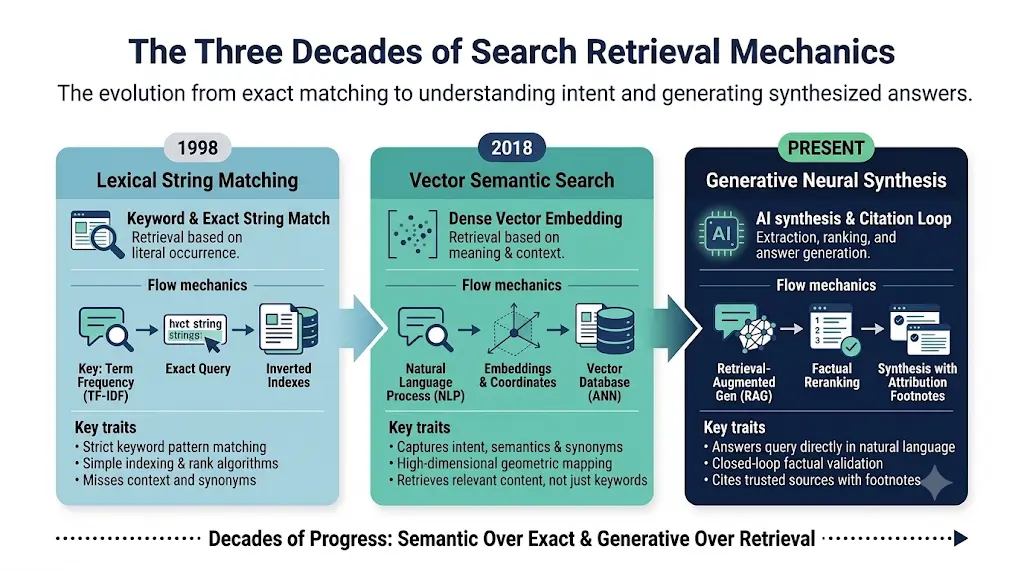
The Architectural Evolution of Search Engines
Understanding where search is heading requires inspecting how retrieval models developed through three distinct computing paradigms:
String Matching Foundations
In the late 1990s and early 2000s, search engines functioned on basic syntactic matching. If an author repeated a targeted word sequence multiple times within document titles, header elements, and body text, the retrieval bot flagged the page as relevant. Search crawlers had no conceptual awareness of what words meant. A query for "cold laser" was processed as isolated characters rather than a therapeutic medical technology. This mechanical framework invited extreme manipulation, low-quality directories, and keyword-stuffing patterns.
Semantic Knowledge Graphs
The paradigm shifted fundamentally between 2012 and 2018 with the introduction of entity-based indexing (such as the Google Knowledge Graph) and neural language modeling. Search engines ceased treating words as strings and began understanding them as entities—distinct concepts, organizations, medical procedures, or people with defined relationships.
Under semantic retrieval, a search system knows that a specific physician practices a recognized medical specialty, operates from a physical clinic, and uses documented equipment. If a page omits the exact keyword but covers the wider clinical ecosystem thoroughly, semantic engines recognize its context and rank it appropriately.
Neural Generative Synthesis
Today, discovery networks operate in the generative era. Engines no longer simply direct a visitor to a third-party webpage. Large language models (LLMs) synthesize information from several sources simultaneously to generate real-time answers. A web property is now evaluated on whether its assertions can be extracted, verified, and cross-referenced by automated reasoning engines seeking clear factual truth.
Deconstructing the Modern Discovery Triad: SEO, AIO, and GEO
The terms SEO, AIO, & GEO are often conflated in general marketing discussions, but they describe distinct engineering layers in the modern discovery process:
| Dimensional Vector | Traditional SEO | Answer Engine Optimization (AIO) | Generative Engine Optimization (GEO) |
|---|---|---|---|
| Primary Environment | Standard Search Engine Results Pages (SERPs). | AI Overviews, Featured Snippets, Voice Assistants. | Conversational LLMs (ChatGPT, Perplexity, Claude). |
| Retrieval Mechanism | Crawl spiders, inverted indexes, PageRank graph links. | Extraction algorithms seeking direct semantic answers. | Vector retrieval-augmented generation (RAG) models. |
| Structural Priority | Crawlability, clean URLs, metadata, schema definitions. | Concise direct-answer summaries, clear list steps, Q&A blocks. | Information gain, institutional consensus, entity clarity. |
| User Interaction | User clicks a link and navigates to the website. | User views an answer on-screen with reference citations. | User has a multi-turn conversation citing multiple platforms. |
Retrieval-Augmented Discovery
Generative engines do not generate facts out of thin air; they utilize Retrieval-Augmented Generation (RAG). When a user poses a multifaceted question, the AI retrieves authoritative documents, breaks them down into dense vector embeddings, and reconstructs a synthesis. If an organization's digital content is filled with vague generalities or marketing hype, the retrieval algorithms discard it because it lacks concrete data to answer the prompt.
The Physics of Backlinks: Authority Signals vs. Manipulation Hazards
Hyperlinks remain one of the foundational ranking signals of the internet, but their role has transformed significantly. Originally designed as peer citations—similar to academic research papers referencing earlier studies—links have been heavily commercialized and misused.
Legitimate Citation Dynamics
An organic backlink occurs when an independent entity voluntarily references your research, clinical protocols, original data, or specialized insights. These links act as genuine endorsements of authority, passing algorithmic trust that strengthens the recipient domain.
Manipulative Link Practices
Purchasing mass links from private blog networks (PBNs), participating in low-quality guest post marketplaces, or swapping reciprocal links across unrelated niches leaves a distinct footprints that algorithmic safety filters easily trace.
Algorithmic Link Devaluation
Modern search engines employ sophisticated deep-learning classifiers (such as Google’s SpamBrain) trained to spot unnatural linking schemes. Rather than simply penalizing sites manually, algorithms now invalidate artificial links entirely:
- Topical Disconnect: A link from an entertainment blog pointing to a specialized medical device platform carries near-zero semantic weight and raises an algorithmic flag.
- Unnatural Anchor Velocity: A sudden influx of exact-match commercial anchor texts signals automated link-building, triggering algorithmic suppression.
- Toxic Footprints: Association with link-broker farms can suppress sitewide organic visibility, requiring extensive disavowal processes and root-cause cleanups.
Information Gain: Authoritative Depth vs. Commodity Filler
The widespread availability of automated text generators has flooded the internet with uniform, superficial content. In response, modern search algorithms have adjusted how they measure document quality.
The Information Gain Metric
Search engines evaluate content based on Information Gain: Does this document provide verifiable perspectives, technical specifics, or data points that are not already present in the existing search index? If an article simply rephrases the top five search results, its information gain score is near zero.
| Generic Filler Writing | Authoritative Information-Rich Content |
|---|---|
|
Surface-Level Generalities "Healthcare technology is constantly advancing to make procedures faster, safer, and more comfortable for modern patients." |
Precise Technical Explanations "Volumetric 3D CBCT imaging reduces radiation exposure to under 35 micro-Sieverts while delivering 75-micron focal resolution for anatomical assessments." |
|
Circumstantial Filler Words "When searching for a trusted professional, it is always very important to do thorough research and check reviews." |
Clear Procedural Criteria "Verify institutional accreditations (such as NABH protocols), evaluate specialist board certifications, and review documented clinical case studies." |
Local Discovery Systems: The Real Engine Behind Google Business Profiles
Local search discovery operates on a specialized infrastructure separate from standard organic search indexes. For institutions, clinics, and localized commercial practices, map rankings are determined by a three-part framework: Relevance, Distance, and Prominence.
Triangulated Local Signals
A Google Business Profile (GBP) does not function as an isolated social card. It is a real-time reflection of an organization's digital ecosystem across the web:
- Landing Page Coordination: The primary URL linked to a GBP must reflect the exact business categories, service definitions, and geographic coordinates indicated on the profile. If the landing page lacks procedural depth, map rankings drop.
- External Name-Address-Phone (NAP) Uniformity: Search engines cross-check municipal registries, official certifications, and industry citations. Conflicting phone formats or addresses weaken location authority.
- Contextual User Feedback: Reviews that naturally reference specific clinical procedures, technical equipment, and professional staff provide unstructured semantic validation that algorithmic filters factor into local rankings.
Internal Link Architecture: Building Value-Driven Authority Loops
Internal linking is often reduced to the mechanical practice of hyperlinking random keywords to related pages. When implemented correctly, however, internal links form the underlying architecture that teaches search crawlers and AI systems how your knowledge is organized.
The Hub-and-Spoke Principle
An effective site architecture organizes pages into logical topical clusters. A central, comprehensive Pillar Page covers a broad discipline at an architectural level. Connected to it are specialized Cluster Sub-Pages that explore individual procedures, diagnostic tests, or technical nuances in complete detail.
The Authority Loop Rule: Cluster sub-pages should link back up to their parent pillar to establish clear topical hierarchy. Conversely, laterally linking between unrelated micro-niches creates topical confusion and dilutes search equity across the site.
Upward Semantic Flow
Detailed supporting guides pass contextual relevance back to core commercial pages, signaling to search algorithms that the main service page is backed by genuine subject-matter depth.
Contextual Clarity
Hyperlinks should be introduced where the user naturally requires deeper explanation. Links should inform, not interrupt, avoiding jarring interruptions in the reading flow.
Anchor Cleanliness
Avoid linking the exact same destination URL repeatedly across a single article. A single, natural contextual reference preserves link equity and maintains a clean user experience.
Frequently Examined Search Concepts
Why does Google penalize websites that publish generic AI-generated articles?
How do AI answer engines choose which websites to cite in their responses?
Is building external backlinks still necessary for modern website ranking?
How does a Google Business Profile interact with a website's overall SEO?
Explore Enterprise Search Architecture
Discover how disciplined information engineering, entity mapping, and algorithm defense can build lasting organic authority for your institution.
Connect for an Advisory Review