AIO & GEO
AIO and GEO in Modern Discovery: Synthesis Engines, Search Dynamics, and Citation Mechanics
The shift from indexing static hyperlinks to synthesizing real-time answers has altered how internet users discover information. The battleground for visibility is no longer just winning the blue link; it is becoming the trusted source that large language models cite within conversational answers.
Between late 2022 and 2024, the public launch of conversational models like ChatGPT, followed closely by Perplexity AI, Claude, and Google's AI Overviews, created an inflection point in computer science and information retrieval. Users began shifting away from entering short, fragmented keyword queries into search bars. Instead, they embraced natural language prompts that demand nuanced, immediate synthesis without requiring them to sift through multiple browser tabs.
This shift introduced two complementary methodologies: Answer Engine Optimization (AIO) and Generative Engine Optimization (GEO). Where traditional search architecture focused on earning rank positions for specific web pages, modern discovery focuses on fact-level extraction, entity trust, and source citation inside neural network outputs.
The Evolution of Information Retrieval
Comparing the linear mechanics of traditional inverted web crawling against multi-dimensional vector embeddings and real-time generative neural synthesis.
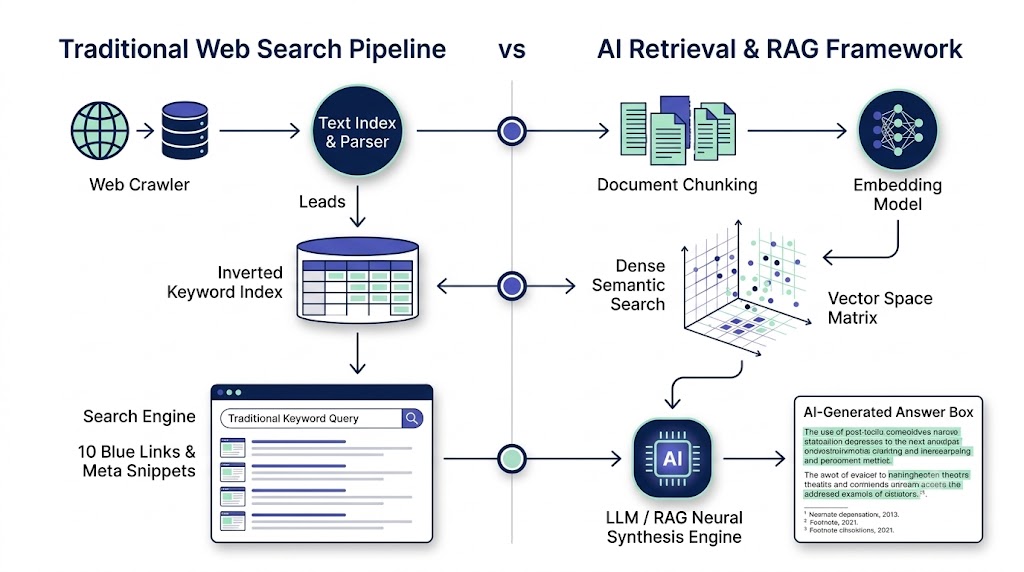
Legacy Web Indexing (10 Blue Links)
Traditional search bots crawl static HTML pages, parse strings into an inverted document index, and rank entire web documents based on keyword matching and PageRank link popularity. Users receive a list of links and must open multiple browser tabs to assemble their own answers.
Vector Retrieval & Neural Synthesis (RAG)
Generative search engines decompose content into dense semantic vectors. Rather than ranking isolated pages, models retrieve high-density informational passages, evaluate factual consistency, and generate a synthesized, direct response with accredited source citations.
The Genesis of Generative Retrieval
The foundation of Generative Engine Optimization began gaining formal academic and enterprise recognition around 2023–2024, marked notably by seminal research from Princeton and IIT Delhi analyzing how content characteristics influence AI citation selection. Before this inflection point, digital marketing operated on the assumption that search engines were indexing systems that directed users to external web properties.
Origins of Generative Retrieval
Early search algorithms relied on inverted document indexes: if a page contained the target term and carried sufficient link equity (PageRank), the engine ranked that document among ten blue links. The emergence of transformer architectures and dense vector embeddings altered this retrieval model. Instead of scanning for matching words, models analyze the mathematical proximity of ideas across multidimensional space.
When generative engines proved capable of resolving complex, multi-layered questions in a single response, user expectations shifted permanently. Rather than researching multiple perspectives across separate blogs, users began asking answer engines to synthesize solutions directly, creating the zero-click search environment that defines the current digital landscape.
The Zero-Click Reality
Traditional search metrics measured success through impressions and organic click-through rates. In the AIO and GEO era, a substantial portion of user journeys conclude directly inside the synthesized answer window.
For institutions, clinics, and professional enterprises, the commercial objective has expanded. Success is no longer purely about securing website visits; it is about brand attribution inside the AI answer. When an engine answers a patient or corporate buyer, your organization's verified clinical data, equipment specifications, or case outcomes must be the cited foundation supporting that synthesis.
The Challenge to Google's Search Monopoly
For over two decades, Google held an undisputed monopoly over global search volume. The rapid adoption of conversational platforms—led by OpenAI's ChatGPT and Perplexity AI—presented the first genuine architectural challenge to that business model.
| System Dimension | Conventional Google Search | Emerging Answer Engines | Integrated Gemini Ecosystem |
|---|---|---|---|
| Access Vector | Manual browser search bar; typed keywords. | Standalone web apps and subscription chats. | Deep OS integration across billions of active Android devices. |
| Interaction Flow | Query entry followed by navigating 10 blue links. | Multi-turn conversational dialogue with citations. | Ambient on-screen context, voice triggers, and instant overviews. |
| Retrieval Architecture | Inverted crawl index and document ranking. | Vector databases and live web search synthesis. | Hybrid Knowledge Graph matching merged with generative summaries. |
| Commercial Model | Pay-per-click sponsored links and visual shopping cards. | Pro subscription tiers and emerging enterprise sponsorships. | Hardware-level lock-in, Workspace continuity, and sponsored AI modules. |
Google's Hardware Defense
Google did not remain passive in the face of generative competition. To defend its market position, Google launched a massive infrastructure counter-offensive anchored by the Gemini model family. Rather than forcing users to open an external app or third-party website, Google integrated Gemini directly into Android's core operating framework.
By replacing the traditional Google Assistant with Gemini, embedding AI-driven multimodal tools across cameras and mobile keyboards, and introducing ambient screen-awareness features, Google ensured billions of daily users interact with its AI natively. With every software update, Gemini becomes more deeply integrated across Android mobile hardware, Workspace enterprise tools, and standard browser workflows, turning Google's distribution footprint into a major competitive defense.
Shifting User Intent
The rise of conversational interfaces has fundamentally transformed user behavior. Historically, a patient or prospective client searched using fragmented phrases such as "dental implant cost" or "dermatologist acne scar." They were prepared to open four or five different websites, read their intros, and piece together the answers manually.
Today, user intent is contextual, comparative, and multi-layered. Users enter complex, conversational prompts: "I have Fitzpatrick skin type IV with post-inflammatory hyperpigmentation; what clinical lasers are safe, what is the recovery window, and which accredited centers in my city specialize in this protocol?" The user is no longer searching for documents; they are consulting an intelligent assistant for a tailored recommendation.
Anatomy of a Retrieval-Augmented Generation (RAG) Citation Loop
How neural answer engines extract vectorized passages from authoritative web assets, evaluate factual density, and synthesize verified attribution footnotes.
1. Ingestion & Chunking
AI crawlers ingest verified clinical or technical pages, breaking unstructured body text down into self-contained semantic passages (chunks). Each block must maintain clear context so that facts remain coherent when isolated from the rest of the document.
2. Vector Scoring & Rerank
Extracted text chunks are converted into dense vector embeddings. When a user submits a query, retrieval models match prompt vectors against candidate chunks, ranking them on factual density, entity clarity, and lack of generic filler words.
3. Footnote Citation Anchor
The top-ranked passages are passed into the LLM context window. The generative model synthesizes the direct response and binds the factual claims to reference citations, awarding visible footnote credit and authority backlinks to the primary source.
Why Citations Are the Modern Currency of Authority
In traditional search engine optimization, backlinks functioned as the primary currency of domain authority. A hyperlink from an external website passed PageRank equity to your domain. In generative discovery, while links still matter, citations have become the primary benchmark of brand authority.
The Hallucination Buffer
Large language models are inherently probabilistic: they predict the next most likely token in a sequence. Because ungrounded models risk generating inaccurate or fabricated information ("hallucinations"), enterprise-grade answer engines employ Retrieval-Augmented Generation (RAG).
Under RAG architecture, the model is strictly constrained to synthesize answers from high-scoring, verified source passages retrieved during the live query. Citations are not aesthetic footnotes; they are the mathematical justification proving the model's statements are factually sound. If your digital content cannot be mapped to verifiable factual sources, the synthesis pipeline discards it.
Fact-Level Optimization
Search engines used to evaluate websites on a document level: did the page cover the overarching topic thoroughly? Generative engines evaluate content on a fact-level granularity.
An answer engine like Perplexity or Gemini might extract a single 50-word paragraph containing clinical statistics or diagnostic criteria from a 2,500-word article, citing that single paragraph while ignoring the rest of the page. If your paragraphs are padded with generic filler, rhetorical questions, and marketing hype, extraction bots cannot parse the core facts, and citation opportunities are lost.
Organizational Challenges in the Generative Era
Transitioning an enterprise or clinical institution from legacy search practices to generative discovery introduces several operational and technical hurdles:
The Generic AI Content Trap
Many marketing teams attempt to scale content production by prompting automated tools to churn out generic articles. Because these machine-generated drafts merely rehash existing web summaries, they offer zero Information Gain. Detection filters and quality algorithms quickly deprioritize them.
Lack of Structured Attribution
Valuable clinical case data and technical expertise frequently remain trapped in unindexed PDFs, complex video streams, or unstructured text blocks. When AI crawlers traverse these assets, they cannot easily extract verifiable entities, authors, or outcomes.
Unfocused Page Hierarchies
Websites built with ambiguous header hierarchies, fragmented content silos, and missing schema markups confuse retrieval parsers. Answer engines struggle to identify the authoritative source within the domain.
Decaying Citation Lifecycles
While traditional search engine rankings can persist for months or years, generative engine citations decay rapidly. Research shows that over half of cited web sources in AI overviews are less than a few months old, demanding systematic content maintenance.
Solving the Extraction Barrier
To overcome the extraction barrier, organizations must shift from publishing generic marketing copy to engineering structured informational assets. Content should be written with clear, self-contained paragraphs where each section delivers an unambiguous, factual statement supported by verifiable data.
The Inverted Pyramid Page Architecture for Generative Extraction
Organizing on-page information into four modular, descending layers engineered for both human reader engagement and autonomous AI vector extraction.
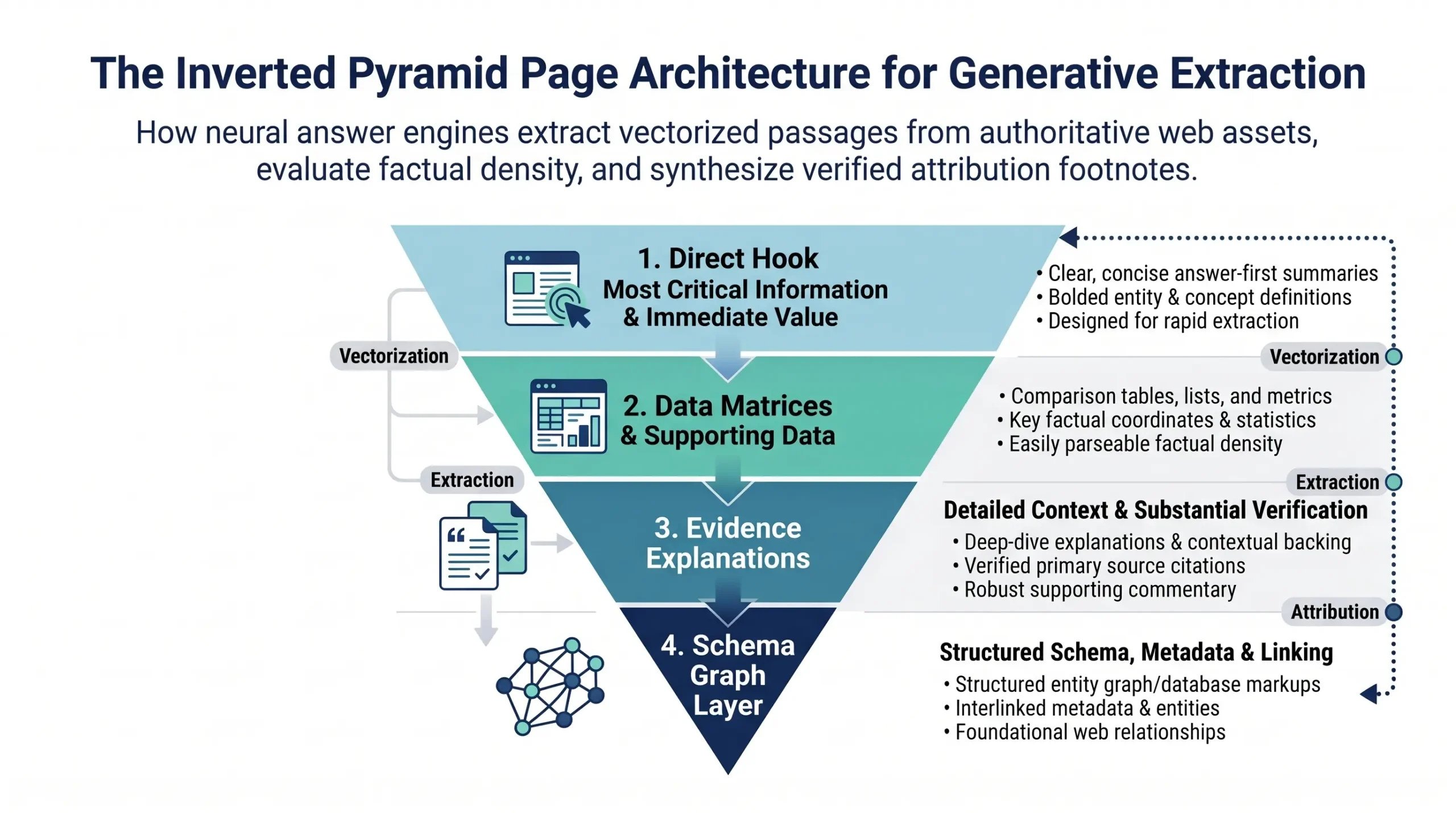
1. The Direct Hook
Positioned in the top 15% of the page. Delivers an immediate, unambiguous 40-to-60 word response tailored for featured snippets and AI direct overview panels.
2. Data Matrices
High-density comparison tables, operational parameters, and clinical metrics that provide clear information gain scored favorably by vector retrieval algorithms.
3. Mechanism Proof
Comprehensive narrative explaining underlying physiological, mechanical, or operational processes to validate real-world Experience, Expertise, and Authoritativeness.
4. Schema Graph Layer
Interconnected JSON-LD arrays linking claims to verified Organization, Physician, and MedicalWebPage entities, removing ambiguity for search crawlers.
Engineering the High-Authority Page Structure for AI Discovery
To ensure both human readers and automated retrieval algorithms extract maximum value, a webpage must adhere to an engineered structural architecture:
| Structural Layer | Engineering Function & Execution | Why AI Bots Cite It |
|---|---|---|
| The Direct Hook (Top 15%) | A clear, unambiguous 40-to-60 word answer to the primary question immediately following the H1 or first H2. | Provides a ready-to-extract passage for featured snippets and AI direct overviews. |
| Structured Data Matrices | Minimalist comparison tables, operational parameters, or clinical metrics contrasting core alternatives. | Tabular data represents high-density information gain that vector models score favorably. |
| Mechanism Explanations | Detailed running text explaining the underlying biology, physics, or technical systems behind the assertions. | Satisfies E-E-A-T depth, verifying the page is an original source of expertise. |
| Schema Graph Layer | Cleanly nested JSON-LD schema (Organization, MedicalWebPage, Physician, FAQPage) tied to authoritative entity IDs. | Removes entity ambiguity, directly linking claims to verified authors and institutions. |
Writing for Bot Extraction
When drafting content for AI extraction, write declarative, fact-rich sentences. Avoid vague introductory phrases such as "In this article, we will explore..." or "It goes without saying that...". State the clinical observation, the operational metric, or the architectural rule clearly in the opening sentence of each paragraph.
Pair complex industry terms with concise lay explanations in brackets. This enables answer engines to serve both advanced technical search queries and everyday conversational questions from a single source passage.
Frequently Addressed Inquiries on Generative Discovery
What is the fundamental difference between traditional SEO and GEO?
Why does Google prioritize Gemini over traditional search on Android?
How does an organization measure its visibility in AI chatbots?
Can purely AI-generated text rank or earn citations in modern answer engines?
Align Your Digital Architecture with Generative Search
Discover how structured entity mapping, information gain frameworks, and generative engine optimization position your organization as the definitive cited authority.
Connect for an Advisory Review